

Memories provide a catalog of subjects for your writing. Especially if your genre is memoir, delving deeply into your past is a natural way to find your subject and focus. If you write about family, specifically about your relationships with your parents or siblings, tapping into your earliest memories can reap a storehouse of material.
However, accessing our earliest memories can be challenging. Memories from our most distant past tend to be cloudy, partly due to the fact that our earliest experiences occurred before we learned to think and communicate with language, and language is a necessary component for memory formation.
Many of us, though, have excellent tools at hand to help us to tap into and reflect upon our own earliest experiences. Family photos (You have a box of them somewhere, don’t you?) may help us to recover memories we have lost, or they may tell a story that contradicts the memories that we have, or they may present us with images of experiences that we don’t remember at all. Photos taken during our early childhood can give us insights into our early lives, our family dynamics, and ourselves.

One thing we have to keep in mind as we begin to examine family photos, though, is how reliable they are as a representation of the reality of the past. In her book Picturing Ourselves, Linda Haverty Rugg asks, “Are photographs (of ourselves in the past) evidence of the existence of things and people in the world? Or are they constructions, manipulable and manipulative, masquerading as fact?”
Haverty suggests that what we see when we view pictures of ourselves in childhood are not representations of ourselves in the past, but rather an alteration of that past self, due to the photographer’s and perhaps others’ manipulation of what the camera records.
Recent scholarly work in the analysis of family photographs has found these artifacts to be a ritualized and ideologically rich territory in which the photographer stages a performance, often one that constructs an ideal or official face that the family projects for itself and others. Haven’t some of us been lined up in rows of family members, positioned based on height, told to face forward and smile, to hold still, as the photographer snaps away? And weren’t some of us assembled in front of an attractive background that speaks of the success of the family? A clean, well-furnished living room? Perhaps the family’s new car? Some other marker of prosperity?
Photos taken of you in childhood may either confirm or contradict the content of your childhood memories. They may give you insights into what a family wants to conceal, the stories they construct to hide unpleasant truths. They may call up repressed memories, or prompt you to try to re-construct details from the past that you have forgotten. But in any case, they provide you with plenty of material to fuel your writing.
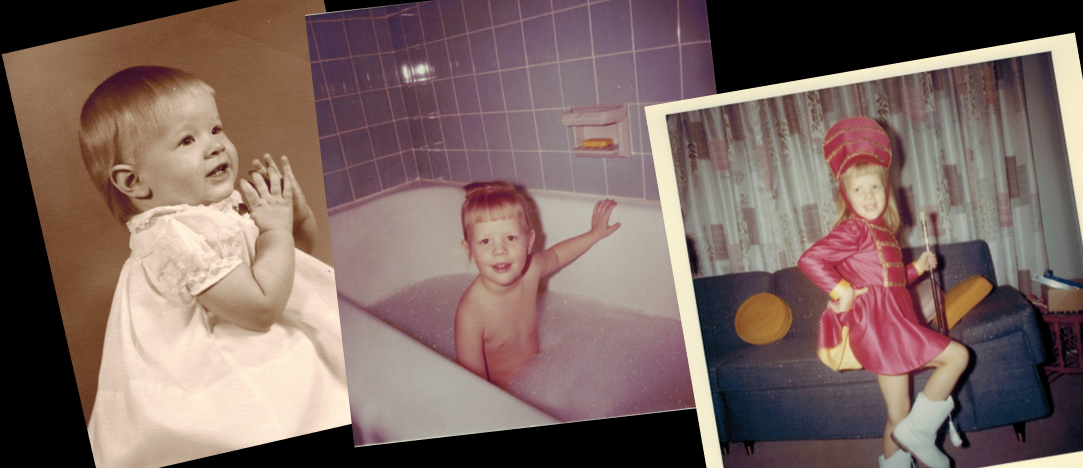
Go find that box of photos, and give it a try. Follow these steps to analyze photos taken of you as a child.

1. Choose photos that are likely objects of analysis. Choose ones that contain a tension, a seeming contradiction, a set of contrasting elements, or an object that does not seem to fit the mood of the image. Then, select photos that elicit a strong emotional response from you, perhaps a response that you can’t articulate at first.
2. Distinguish between two kinds of childhood photos.
Photos that call for speculation. These are photos that represent an occasion that you do not remember. They may have been taken of you in infancy, or early enough in your childhood that you do not recall the moment the photo was taken.
Photos of remembered events. These are photos that record a moment that you do remember. You may remember who took the photo, what prompted the photographer to take it, and what was going on surrounding what is captured in the image. These kinds of photos may help you recall forgotten details of the occasion, or they may provide information that challenges your memory.

3. Choose one photo, and begin writing.
- Begin at the surface level of the image and move inward to the details.
- Look at the photo as an historian, identifying the time, location, and occasion.
- Look at the photo as its subject, a participant in the scene depicted. Note what you recall, or do not recall, about the occasion, about yourself at the time, about the person who took the photo. Note whether the image corroborates or challenges your memories.
4. Using your imagination, step into the photo and look around.
- What is happening outside the border of the image?
- Who is staging the photo?
- What may be concealed by the way the image is staged and situated?
Try this process with a number of photos. Are there common themes that present themselves? Does what you see surprise you when you compare the images to your memories? Do you see evidence of the family dynamic as you experienced it while growing up? Is there a story behind the story that the photos convey?
Look closely. Make discoveries. Gain insights about yourself and your past.
Then write.

 Person on the Page
Leave a comment