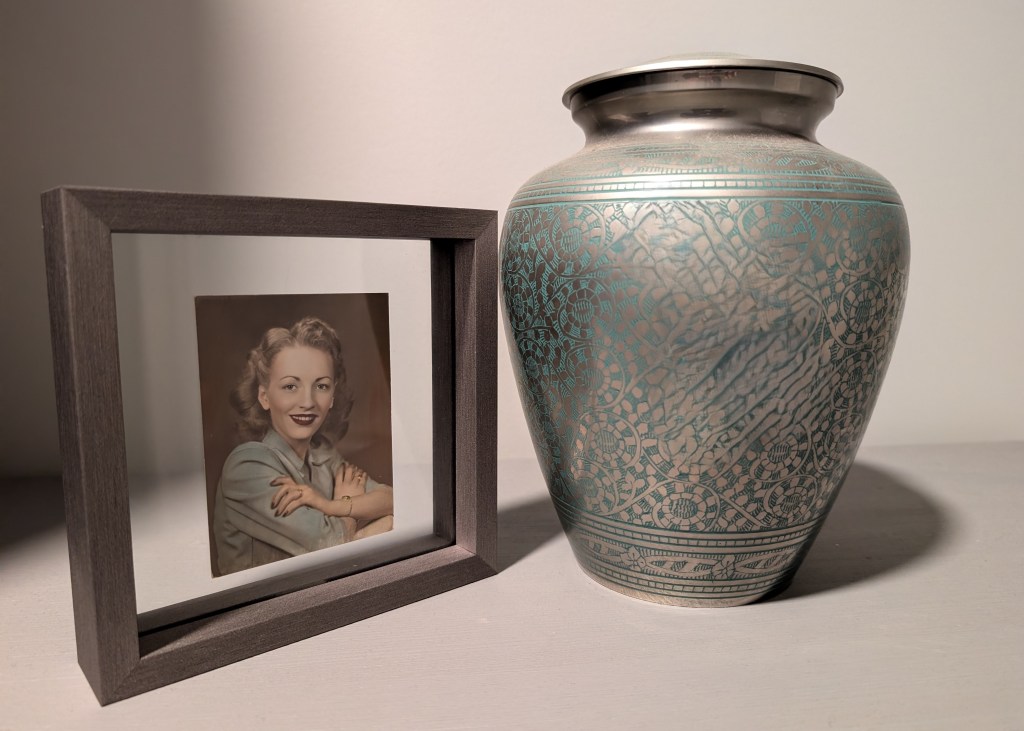
When your final illness ended and you were gone, I brought your ashes into my home. I placed them in an urn — one that would rest easily on a bookshelf or mantel, one that would be inconspicuous, that would blend in with my other belongings and perhaps go unnoticed by visitors.
I decided to keep your ashes with me. To watch over and protect them, yes, as a good daughter might. But I decided to keep them for another reason.
Death silenced you, I thought. You could no longer tell me your grievances, point out my failings, or remind me of all the ways I had disappointed you. You could no longer abuse, control, threaten, or malign.
Now would be my turn to talk, I thought. To lay myself bare and show you the damage your words inflicted on me over the years. To finally break the silence you always demanded of me.
You were gone. The urn was not you — I knew that. It held only what was left of you. I would talk anyway.
I would talk to dust.
. . .
I used to think of time as a line. Straight, like the one my first-grade teacher drew with chalk on the blackboard to teach us about numbers. Long, with arrows at each end pointing into infinity.
We march the line of time, I thought, like walking a tightrope. Our experiences imprint themselves like notches along its length as we step steadily — heel-toe-heel-toe — away from them. We leave the past behind us. We can never turn back. We can only remember.
Now I have lived for a while — a long while. I have accumulated experiences and loved and lost people.
Now I think time is a plane. Stratified — our present overlying our past. Layer upon layer, each period of our life spreads itself onto the period before. Each layer covers the one before, but never fully obscures it. The plane of time holds past and present together.
Loved ones who have left us have never really left us. They abide with us within that plane. Invisible, they make their presence known, signaling to us in ways we cannot fail to sense.
. . .
Mom, when you were gone, I thought that death would silence you. But I was wrong.
You’re still here.
When I’m at home, tending to daily tasks — cooking, cleaning — I still hear you telling me, You’ll never be able to cook like your mother, will you? You’re not doing that right. That dish didn’t turn out right, did it? I could have told you. Your house is a mess. Why can’t you be tidy? You can’t invite people into this place. They’ll talk about you. It’s a shame. Shame on you.
When I go out, when I meet and talk with people, I hear your voice, still telling me, People talk about you when you cannot hear. They’re laughing at you behind your back. Be quiet, so no one will know how stupid you are.
I still hear your numerous and sometimes contradictory complaints. You’re too thin. You’re too fat. You’re too pale. Wear more makeup. Smile more. Try to look pretty.
I know you’re not the only one. Other mothers say these kinds of things to their daughters. Other mothers criticize until every particle of the daughter’s self-esteem is crushed.
And I know I’m not the only one. Other daughters suffer. They do their best to live under the weight of their mother’s words.
But why?
. . .
For a long time, I avoided the urn. I placed it on a bookshelf in a dark hallway where I could pass by without seeing it. I pretended it did not matter that it was in my house. It was just part of the décor. Something no one noticed.
And I pretended that I could let go of the past — that it didn’t matter anymore. I didn’t need to talk to the urn because I had moved beyond the painful times.
I avoided thinking about the damage done to me, thinking it would go away.
But not tonight. Tonight it’s time to talk.
It’s late. It’s dark here in my house. Only candles in the windows light the night. The house is quiet. My husband is asleep. I married him after you died. He never knew you, and knows next-to-nothing about you. He doesn’t know I’m up, talking to ashes.
. . .
Do you remember the time I showed up at your door one evening, distraught and depressed? I was in my twenties, newly married, and desperately unhappy. Remember?
I came to you for advice. For support and comfort. Didn’t it make sense to come to you? A woman who had been through failed marriages, who had experienced disappointments herself? A woman older and wiser than I? My mother. Doesn’t it make sense for a young woman — struggling in her marriage, unhappy — to come to her mother for help?
When I arrived at your door, you told me that you were in the middle of cooking dinner, that you didn’t really have time to talk. But you let me come in. You let me sit down in your living room. What was it I wanted, you asked.
I explained how unhappy I was. That I feared my marriage was a mistake. My life seemed to be heading nowhere. It seemed as if it were over already. I had dropped out of college to get married, sacrificed my own dreams to support a husband as he chased his.
“I think I made a huge mistake,” I told you. “I think I want out of my marriage.”
Do you remember the way you looked at me that day? The way you stared at me, puzzled, as if I were speaking a foreign language? As if I were speaking words you had never heard before, or saying something so objectionable you couldn’t comprehend.
“Don’t be ridiculous,” you said. “Just shut up. You have made your bed,” you said. “Now lie in it.”
With that, you left me and went to the kitchen. After a moment, you returned, seemingly livid.
You said, “Do you know what you’ve done? You’ve distracted me and now I’ve burned my dinner. My dinner is ruined. How dare you! Why did you come here and interrupt me? Go back home to your husband! I don’t ever want to hear any more about this again.”
Remember, Mom?
. . .
I’ve heard that time is a healer. That it covers all wounds and allows us to survive painful experiences.
The passage of time, I’ve heard, allows us to overcome the sting of words. To forgive those who spoke them. To forget. To move on as if the past no longer exists.
If all those things are true, why haven’t I been able to move on? Why haven’t I gotten over your words? Why do I still hear them, as if you are still here with me? Why didn’t your death loosen your grip on me?
Many live with the damage caused by their parents’ words. Many continue to hear those words, even after their parents have died.
The dead stay with us. We hear them speaking, long after they are gone.
. . .
Since that day I came to you hoping for advice, I have lived a long time. I maintained an unhappy marriage for too many years, raised two children, divorced, finished college, and had a career. I guess I can say that everything eventually turned out all right.
Recently, I remarried. I now live with someone who accepts me as I am. Someone who supports and encourages. Who provides comfort when I need it. I am no longer criticized or dismissed as annoying.
I live in a home where I am loved. Living this way feels strange. Sometimes I don’t trust what I am experiencing. It can’t be real. I keep waiting for the criticisms to start. Here in my home, I listen for harsh words, but all I hear is the quiet of peace.
Except for your voice, which I still hear in my mind.
. . .
Here in the dark, Mom, you and I are alone. Will you finally listen to me?
I’m ready to move on. That’s why I am talking to you now.
I know that you had many challenges in your life. Perhaps you had good reasons for the things you did. Perhaps many parents, plagued by their own pasts, have good reasons for treating their children as they do.
But really, was it all necessary? I imagine what my life might have been like if you had accepted me, loved and encouraged me, treated me with regard for my self-esteem. Would that have been so impossible?
Words matter. They strike like arrows. They stick and stay, echoing from the past into the present.
Your words have outlived you. After you were gone, they remained.
But not anymore. I love you, Mom.
But it’s time for you to go.
Photo: by Georgia Kreiger


 Person on the Page
Leave a comment