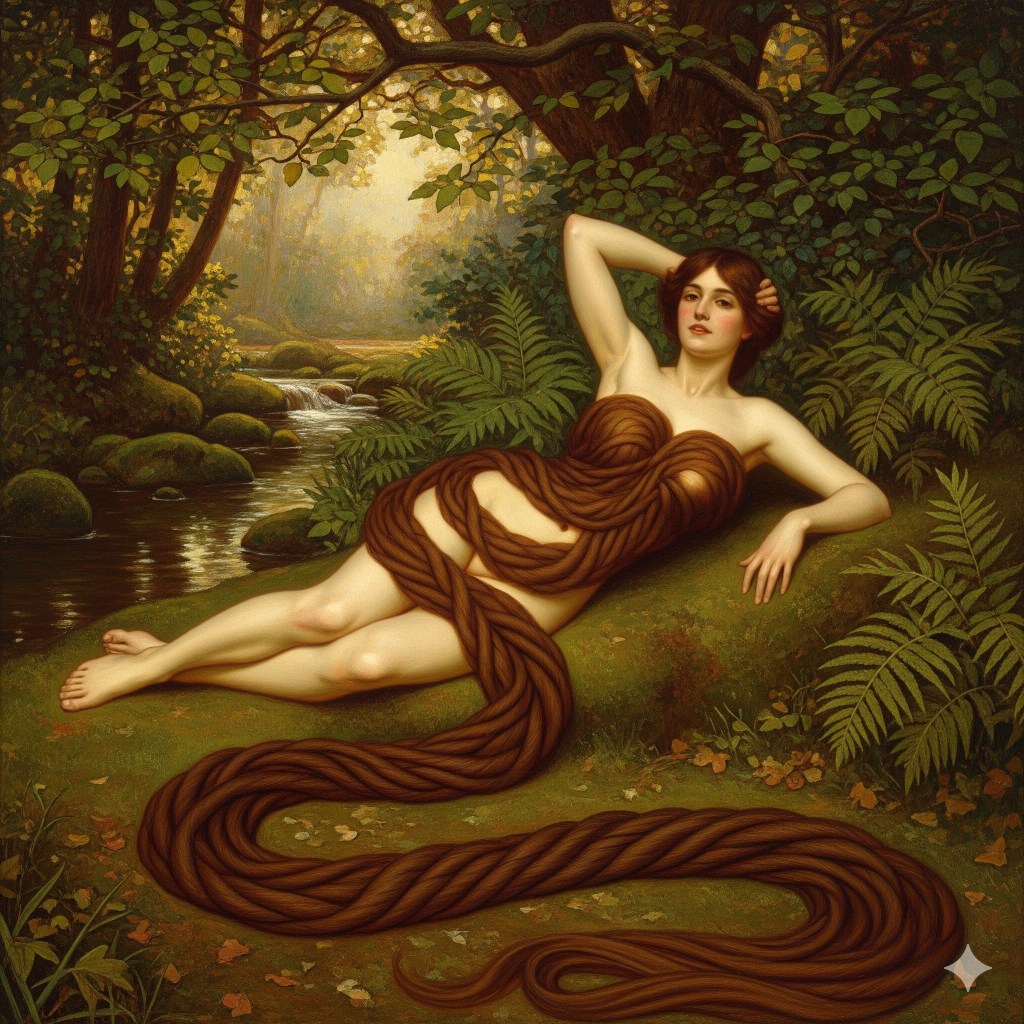
When Aunt Dinny stood with her bun undone, her wavy auburn hair hung down to her ankles.
As a child, I once watched as she sat at the vanity in her bedroom dividing the long tresses into segments and brushing each one vigorously—her bedtime ritual. Between segments, she took dainty bites of a cucumber finger sandwich.
Mother warned that it was unwise to eat at night. “If I ate before bed, I’d see my grandmother!” she declared.
But Aunt Dinny said she couldn’t sleep unless she had a little food in her stomach.
When she said she’d see her grandmother, I didn’t know which of her grandmothers Mother meant. Grandma True, with whom she had spent summers as a child, or Grandma Swain, a mysterious blank spot on the family tree who died long before Mother was born.
Whichever one she saw, did she mean that eating at night caused her grandmother to appear before her, a chimera, as she lay in bed? Or that she had nightmares in which her grandmother figured as a villain? Hallucination or dream? Discomfited by the alternatives, I never asked.
On the wall over Aunt Dinny’s vanity hung pictures of her naked.
Twisted into a rope, her hair was laid strategically across her breasts and curved down over her torso, where it covered, just barely, the area between her legs. She called these her “boudoir portraits,” and said she had them taken as a gift for Uncle Harry, during a happy time of her life when they lived in Rock Hill, South Carolina.
Uncle Harry died shortly after the portraits were given to him, in his 40s, leaving her with a pale eight-year-old son whom she described as sickly.
Widowed, she packed up her child and moved back home to Western Maryland to be near her family. She served, from that point on, as her son’s self-appointed physician—diagnosing, prescribing, and treating the growing number of illnesses from which she believed he suffered.
Her five sisters sometimes whispered that she was more precisely her son’s jailkeeper—preventing him from going to school because of her concerns about his health, depriving him of contact with other children, subjecting him to her constant surveillance.
During the day, Aunt Dinny wore her hair pulled back and wound tightly in a bun that her sisters said made her look severe. It perched at the nape of her neck like an oddly placed pillbox hat, held to the back of her head by U-shaped hairpins that sometimes worked their way loose as she went about her day. Once I sneaked up behind her and pushed one of those hairpins, as gently as I could, back into place. If she knew what I’d done, she didn’t let on.
To me, she had the air of exiled royalty, as if she were a displaced noble surveying the squalor into which she had fallen through no fault of her own. She held court over her brothers and sisters, ordaining what should be done and who should be doing it, as they lived on, conducting themselves as they would, seemingly unaware of her authority over them.
Often she peered off into the distance—to a place and time lost, perhaps. A world where her divine right was recognized. She seemed to be enduring, waiting stiff-spined, for the restoration of her queendom.
One night, perhaps after sneaking out of Mother’s gaze to snatch a forbidden snack before bed, I saw Aunt Dinny’s auburn waves come to life.
The rope of her hair rose reptilian and slithered toward me, wrapping itself, boa-like, around my neck, catching me up in its powerful squeeze.
…..
Cover Photo: AI generated by Gemini
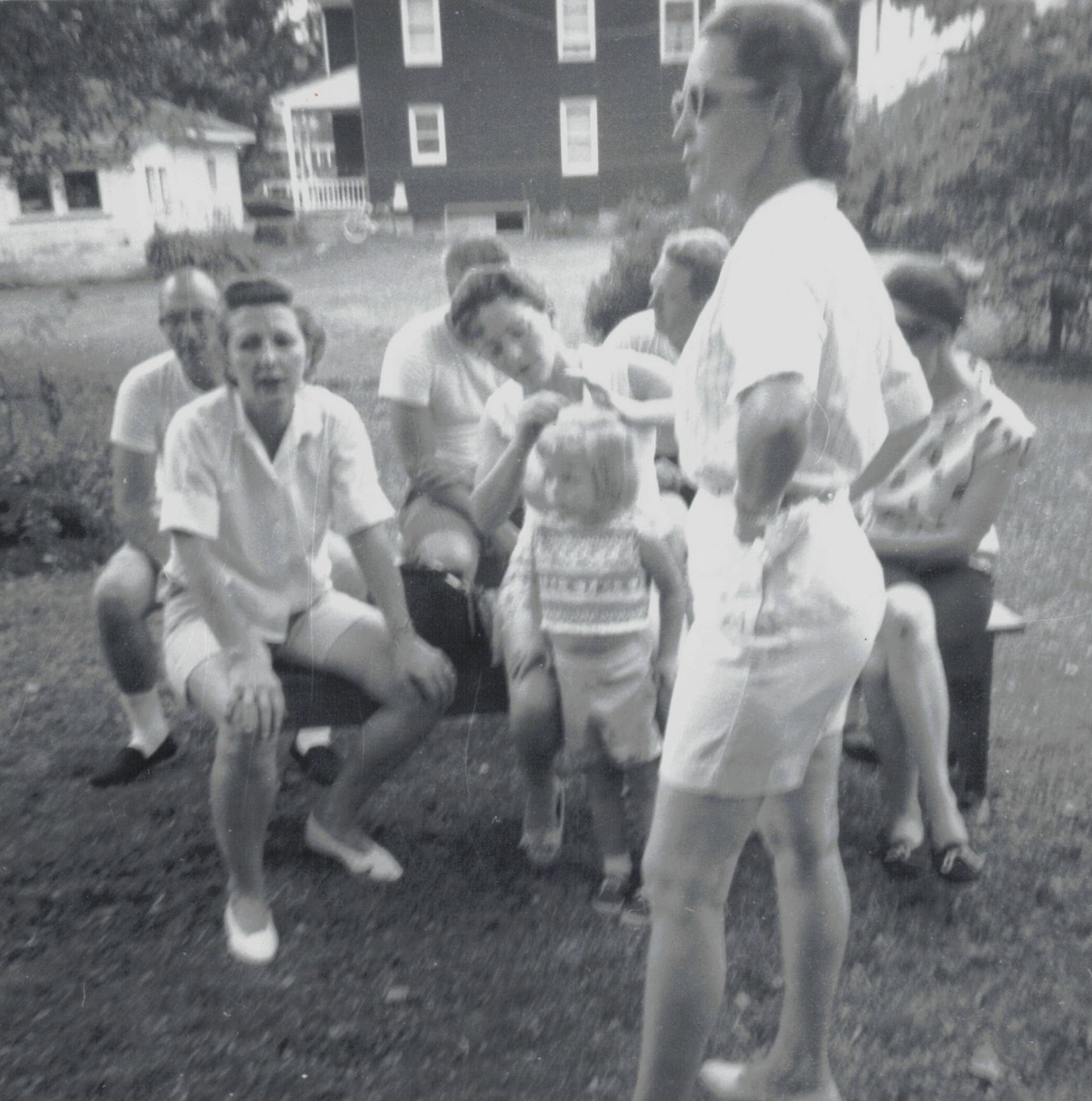
In-text Photo: Grandparents’ anniversary picnic, 1963

 Person on the Page
Leave a comment