I love her Company Pot Roast recipe. Her cocktails are delectable. And her desserts — well, her Outrageous Brownies alone should earn her a standing ovation. On her Food Network show, The Barefoot Contessa, her casual, conversational instructions for preparing dishes that are both simple and elegant delight her many fans. And her repeated declarations of love for her husband, the man to whom she’s been married for 57 years, surely add to her appeal.
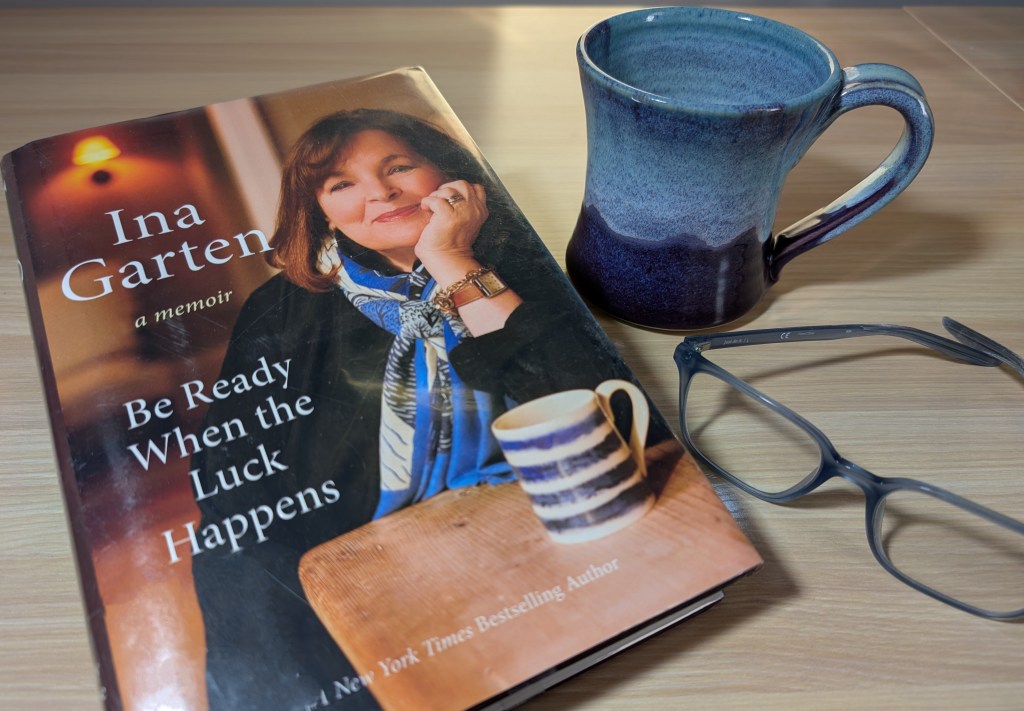
Ina Garten’s 2024 memoir, Be Ready When the Luck Happens, reveals that she is a born entrepreneur, a shrewd businesswoman, an excellent cook and hostess, and a skilled television personality. When it comes to showing her fans how to host a dinner party without becoming overly stressed, how to assemble an attractive crudité platter, and how to roast a chicken any husband would savor, Ina is a clear success. When it comes to writing a memoir, however — not so much. Her book leaves a bad taste.
The memoir is written in a chatty, girlfriendy style that gives the impression Ina is sitting across the kitchen table from her reader, reminiscing about her triumphs and misadventures while she dishes a little dirt on Martha Stewart. The narrative is full of the kind of unnecessary details and too-quickly-summarized lessons learned that someone talking off the cuff might include.
And it’s smattered with parenthetical asides that may make readers feel as if she’s talking to them rather than writing. Statements such as “I was wondering which ingredient would make the flavor of my chocolate cake really POP (it’s coffee, by the way)” and exclamatory interjections such as “The house had a huge double living room (with two fireplaces!) looking out on a beautiful private garden.” In fact, the story is littered with so many exclamation points that we might imagine the rise in pitch and volume of Ina’s voice as her excitement builds over the details she shares.
Who’s your audience, Ina?
One of the basics of good writing — any kind of writing — is audience awareness. Who are the writer’s perceived readers? What are their interests, needs, vulnerabilities, and aspirations? How can writers use their words with connect to them? How can writers use their writing to benefit readers?
Memoir writers face the added challenge of telling their own stories without appearing to be entirely self-absorbed. To do so, they write with their readers in mind. How will readers respond to their accounts of personal experiences? How will they relate to the writer? What’s in it for readers?
The conversational style of Be Ready When the Luck Happens might suggest that Ina is aware of her reading audience (she’s picturing us across the kitchen table from her, right?) and that she writes her story, like any good writer, with her audience in mind.
But, sadly, she doesn’t.
Instead, she seems oblivious about the demographics of the fans who will pick up the book to find out how they, like Ina, can be ready to take advantage of fortuitous opportunities in their own lives. Her title appears to be a direct address to her readers, an imperative to be on the lookout for good luck and to capitalize on it when it arrives. Be ready, she seems to say directly to us, when opportunity knocks at your door. And her book, she seems to suggest, is her nugget of wisdom offered to us, built from depictions of her own experiences, about how to take advantage of those lucky breaks.
That is where her seeming awareness of her readers ends, however.
Ina narrates the events of a life marked not by luck — far from it — but by privilege. An affluence that few of her readers can fathom, much less experience themselves. Born into an upper-middle-class family that could afford her the advantages that foster success, she married a smart, upwardly mobile man, Jeffrey Garten, who encouraged and helped to finance her dreams. When she happens upon a specialty food store in the Hamptons, one of the wealthiest areas of the country, she can purchase it without hesitation. When she runs into a crisis stocking that store during the height of the summer season, Jeffrey can purchase specialty foods at retail prices from another store in order to supply her and thus save the day. All of that takes money — or access to it.
While Jeffrey is portrayed in the memoir as a blandly good-natured, overly accommodating yes-man to Ina’s authoritative drive and ingenuity, he was actually a high achiever himself: successful in business, banking, government, and academia. Much is going on behind the scenes as he is depicted supporting Ina’s every whim.
When she wants to separate from him for a while so that she can focus on her career without disruption, Jeffrey says, Sure! Later, she wants to purchase and renovate an apartment in Paris. Jeffrey says, Sure! Though as a character in her book he is as flat as a complicit johnny cake, Jeffrey was undoubtedly a significant force behind the achievements she attributes offhandedly to luck.
How many of Ina’s readers can even fathom the wealth, connections, and resources that, throughout her rise to success, were at her fingertips? Not this reader — that’s for sure. And how many of us have the unconditional support of a wealthy and powerful partner? Few, I dare say. We may hope for luck to help us realize our dreams. But we can’t even dream of the advantages that seemed to make the realization of Ina’s dreams inevitable.
Reading her story may leave her fans feeling frustrated and inadequate. Is that what she intended?
The bait and switch
When she wrote Be Ready When the Luck Happens, did Ina care at all about us, her readers? Did she care that we were out there waiting to pore over her words? Did she write to us?
Clearly, no.
As she was writing, did she set out to inspire in us feelings of inadequacy and dissatisfaction with our own less lucky lives?
Probably not.
Probably, she didn’t think about her readers at all. Except perhaps to hope that we would buy her book.
Not until the end, in the epilogue, do we learn that the title that seems to be Ina’s imperative to her readers is not that at all. It is merely a loose paraphrase of a comment made by Liza Minelli in 1983.
So, Ina lures us into picking up her book with the seeming promise that she will share her insights with us about how, like her, we can recognize and take advantage of luck when it comes our way. She creates the impression that she is writing with her reader in mind. What she actually delivers is the narrative of a privileged life and a career bolstered by wealth and good connections.
I love Ina Garten. And I enjoyed her story.
But after reading it, I felt somewhat cheated.
…..
Cover Image: Property of Author


 Person on the Page
Leave a comment