
Have you ever noticed how writing experts tend to trip and fumble when they try to explain the concept of voice in nonfiction?
They may say that voice is that undefinable something that makes your writing your own. It’s the magic on the page that allows readers to recognize you, the speaker of the text, as you, the person.
For you, a writer dedicated to perfecting your writing voice, that definition is helpful, isn’t it?
No?
They sometimes say that voice involves the idiosyncrasies in your writing. Your wry wit, for instance. Your preference for meandering sentence structures that wind around your topic and tie it up in a rhetorical bow. The passion that you splash onto the page in vivid words and images.
Surely that is more helpful. After all, wit and passion are easily defined and quantified, right?
Wait. Did I see you shake your head?
Some say that you cultivate your writing voice by reproducing your speech patterns on the page. Listen to yourself talking. Record yourself, and then write down what you hear yourself saying.
Nah.
You know what fiction writers have always known about their fictional characters—that to appear natural and real, dialogue must be carefully crafted. It is not like our speech patterns, but it must seem to the reader as if it is.
Others define voice as the lens through which you, the writer, see the world.
That sounds nice. It has a ring to it.
But . . . huh?
Some suggest that to develop a strong voice in your writing, you should get a test tube. Pour in just the right tincture of word choice, an exact measure of well-designed syntax, a spritz of appropriate tone, and a drop or two of well-considered point of view. Shake. The chemical reaction that results causes your unique voice to bubble up out of the tube and fizz onto the page.
Sounds messy.
. . . . .

You probably agree with all those writing experts that voice is essential to good writing. But, seriously, what is it? And more importantly, how do you achieve it when you write nonfiction?
Nonfiction, particularly the personal essay, has been dubbed the genre of personality. Readers of nonfiction may not distinguish the message from its author. The messenger and the message are one.
So, nonfiction writers are challenged with getting themselves onto the page. Their writing depends upon their ability to achieve a strong and distinctive voicein their writing.
It should be easy, right? Take something as intangible as personality, and reproduce it on the page with something as intangible as language.
No?
Convert the quirks, the quibbles, the foibles, the noble dreams and the bittersweet memories that constitute you—your personality—and convert them into a series of symbols, line after line of them, on a page.
The effort may confirm the adage that nothing worthwhile is ever easy.
It may not be easy. But the key to cultivating a strong voice in your writing is simple.
Let’s step back in time for a moment and visit Virginia Woolf. It’s 1922. Woolf is exploring the character and purpose of the personal essay. She is specifically interested in the relationship between essayists and the voice they cultivate in their writing.
In a piece titled straightforwardly “The Modern Essay,” Woolf sums up the difficult-to-pin-down relationship with this troublesome conclusion: “Never to be yourself and yet always—that is the problem.”
Besides imitating Shakespeare’s use of antithesis in Hamlet’s iconic line from his most famous soliloquy (To be or not to be—that is the question), in this comment, Woolf answers the question of how voiceis achieved.
To represent yourself as an authentic you in your writing, you must create something other than yourself on the page.
Or, as Carl Klaus writes of Woolf’s statement in his book The Made-up Self: Impersonation in the Personal Essay, the self to which Woolf refers is “the product of art and artifice rather than an unrehearsed emanation of the self.”
To inject your writing with authenticity, you have to create a character who speaks for you—what writing experts would call a persona.
Ironic, isn’t it? But isn’t life full of delicious ironies? Sometimes you have to be cruel to be kind. You may have to give to get. And to present yourself as authentic, you have to be artificial.
. . . . .

How do you, a nonfiction writer, develop voice in your writing? How do you, a jumble of longings and dreams, fits and failings, triumphs and disappointments, honorable aspirations and ignoble intentions, present yourself as the inimitable speaker of your message?
Step away from yourself, view the amazing chaos that is you, and make critical choices about what’s important for readers to know and what they can appreciate your written message without knowing.
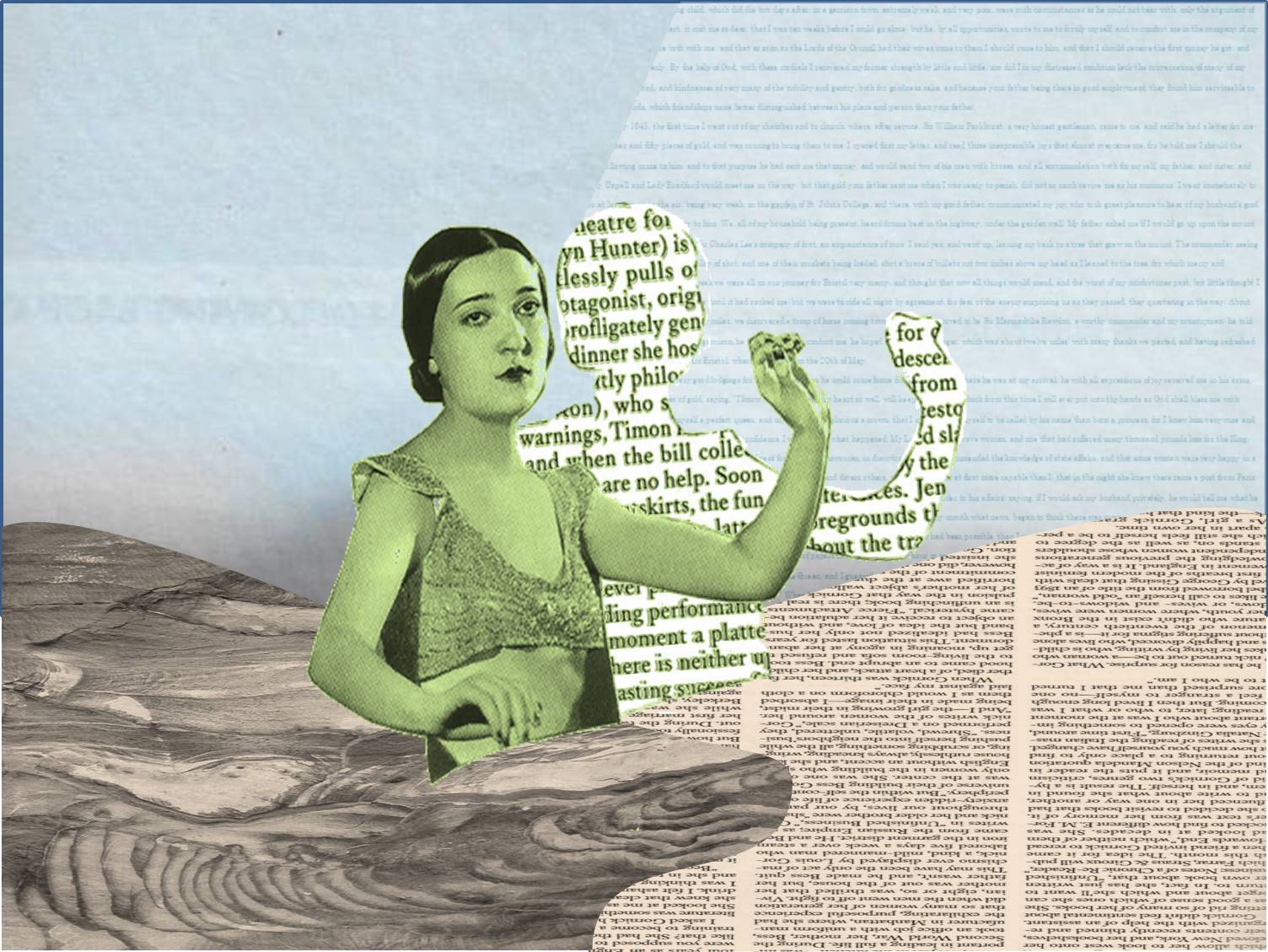
Then, turn what’s important about yourself into a persona that performs you the way an actor performs a character.
You already perform yourself every day, don’t you? You play the roles of parent, partner, employee, friend, and sometimes foe every day.
Likewise, the I that speaks in your writing is a construction, and you are its builder. How do you lead readers to feel that they know you without meeting them face-to-face, interacting with them, and allowing them to experience you directly? You create a persona—a fictional speaker of your message who makes the abstraction that is you seem knowable.
The I who speaks may be created to be likable, or maybe annoying, funny or brooding, self-promoting or self-deprecating, or a contradictory combination of these qualities—all by what you, the writer, choose to present.
To create your persona, distance is key.
See yourself as an observer would, from a position external to you. Float above yourself and watch. Replay your past experiences and look at the past you from the perspective of the present you.
Then, from what you have observed, choose just enough of the right details to create the persona—the voice—that you want readers to sense in your writing.
So, when you write nonfiction, don’t try to convey you, the voice of your writing, by relying on magic; or through chemical reactions that mix syntax, tone, and word choice; or by reproducing your speech patterns while writing.
Instead, follow Virginia Woolf’s advice: Never, yet always, be yourself. Be yourself, but be the self that you consciously create.
All the world’s a stage. And so is the page.


 Person on the Page
Leave a comment