
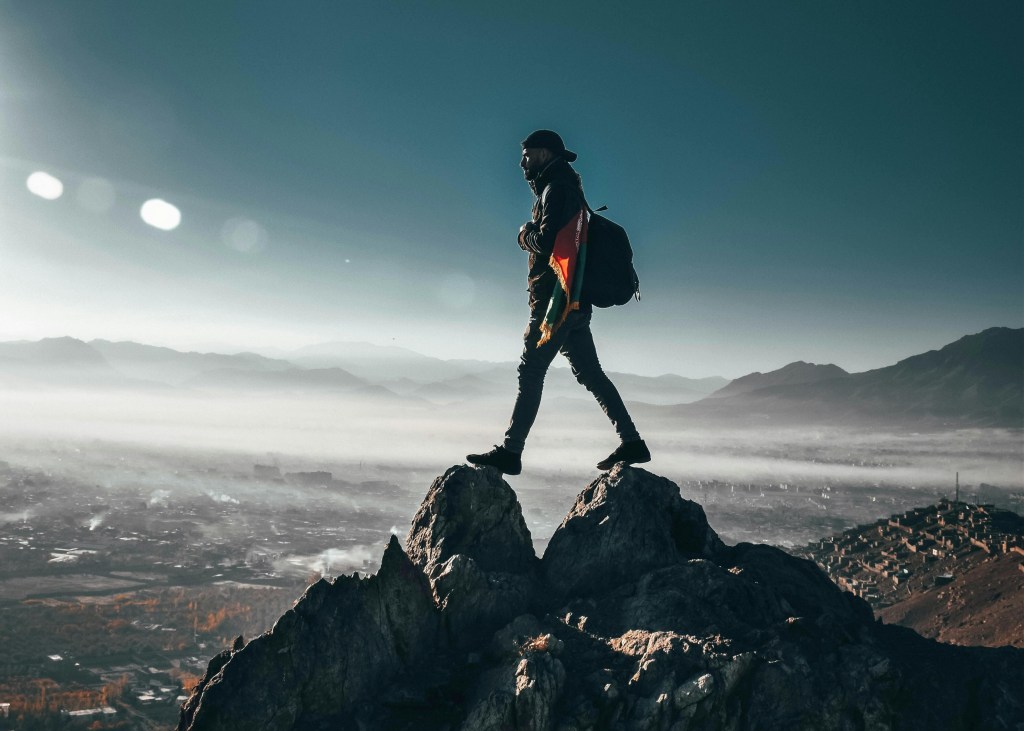
“Chuck all that!” says GCHiker in his YouTube video Why I Avoid People.
Responding to health experts who advise older people to maintain social contacts to avoid a variety of age-related health problems, GCHiker heartily disagrees. An intrepid hiker and solitary wanderer, he says he has grown quite comfortable in his later years with being alone.
Confessing that he crosses the street to avoid having to greet and talk to someone he knows, he reasons that, “after 10,000 conversations, what is new to be said?” Friendships, he says, are less rewarding than they used to be, and time on his own is more enjoyable now that he’s older. Maintaining relationships with people is, for him, a waste of time.
Hiking alone affords him the solitude he now finds necessary to his happiness. “There’s no one on the trail as far as the eye can see, and I’m loving it.”
While GCHiker’s viewpoint seems extreme to me, I applaud his resounding snub of the standardized view that older people need to be socially active.
……….
I was an only child. My father, a World War II veteran who suffered from PTSD, was what my mother described as “nervous.” He couldn’t tolerate noise in the house or children scampering around knocking things over. So, when I was little, I wasn’t allowed to have friends come to visit. I played alone, peopling my days with imaginary companions and dreaming up games and adventures for myself.
Perhaps as a result — or perhaps not — after I grew up, I always desired at least a modicum of solitude. For years, work weeks filled with continuous social interaction were followed by retreats into the peace of my home on the weekends, where I enjoyed hours of quiet, the comfort of pajamas, toast and tea by the fireplace, and deep dives into reading, writing, and reflection. If I learned to like solitude as a child, I learned to love it as an adult.
Now I’m older. I have retired from my job, and I face the time ahead, hoping to maintain my health and vitality for as many more years as I can. I know what the experts say. I must be diligent about maintaining social contact. Otherwise, I render myself vulnerable to an avalanche of ills: cognitive decline, depression, and despair, as well as a greater risk of heart disease, high blood pressure, and stroke.
But how much social contact do I need? How many meaningful relationships must I have? And with whom?
I like people. That’s an understatement. I love people.
I spent my career as an academic caring for students and watching them grow and change during their college years. I was the professor students came to with their problems. I was the one in whom they felt comfortable confiding. And I was the administrator my institution chose to mediate disputes between students and faculty members. I was the one my institution appointed to listen and respond to parents’ concerns and complaints. I am good at interacting with people.
When I retired, I followed the experts’ advice. I cultivated a social life. I led community writing workshops, joined a book group, remained active at my church, took daily walks through my neighborhood, waving at my neighbors and exchanging pleasantries.
Now, a year later, I have to force myself to be socially active. I come away from meetings exhausted; interactions leave me feeling depleted. I push myself, because I’m told these activities are good for me. But I wonder.
Is there anything really wrong with solitude? If I’m happier spending my time alone, am I putting my health at too much risk?
I don’t think so. And I say that for two reasons.
1. Solitude is not the same as loneliness
Experts warn that people who suffer loneliness in their later years may lapse into overeating, drinking too much, and sleeping too little. They may not exercise. These habits can lead to psychological disorders and physical ailments that leave them vulnerable to life-threatening diseases.
Loneliness is painful. And it can be dangerous for older people. But an older person with few social contacts is not necessarily lonely. Being alone and being lonely are two different conditions.
For those of us who have grown up experiencing solitude and who have sought it as adults, the desire when we are older to retreat from social situations may be natural and healthy. Social isolation may be just the condition we have worked hard all of our lives to attain. Why push ourselves now to be socially active when the opportunity to enjoy plenty of time alone may be what we’ve always wanted?
The results of a 2022 study published in the International Journal of Behavioral Development indicate that one of the most significant differences between loneliness and solitude is that people do not choose to be lonely, but they may choose solitude. The study finds that older people have a more positive perception of spending time alone because they make an autonomous choice to do so. Everyone benefits from voluntary time alone, but older people may be more likely to have the luxury of choosing to spend time in solitude.
2. Rather than isolating older people, solitude can free us
The above-mentioned study suggests that, rather than limiting older people and leading to a decline in health, spending time alone can be liberating, specifically in that “solitude has potential benefits such as freedom of choice, relief from stressors, or opportunity for spirituality or creativity.”
While we may not join GCHiker in dismissing interactions with others as a waste of time, we may consider a consciously-orchestrated social life an interruption of the solitude we have always felt we needed. It may take us away from the subjects we’ve always wanted to study, the exercise we didn’t have time for earlier in our lives, the spiritual quest for which we always knew we were destined, or opportunities throughout each day simply to enjoy the calm of a quieted mind. A social life may be enriching and health-promoting, but solitude has invaluable benefits, too.
Like most advice generated by the healthcare industry, the warning that seniors must be socially active or sacrifice their well-being surely doesn’t apply to all of us. Some of us thrive on time alone.
So, the next time I’m asked to lead a workshop, or I’m expected to attend a church meeting or invited out for dinner with friends, I will be more tempted than ever to retreat to my home office where my studies await me, or settle in by the fireplace with a warm cup of something and a book.
For me, solitude is a reward.
Cover Photo: Sullman Sallehi at Pexels


 Person on the Page
Leave a reply to Georgia Kreiger Cancel reply